
6.29.2011
Lowell’s Constant is 1.15, or more specifically, 2/√3
Since yesterday was tau day, 6.28, my boss and I were discussing the significance of the number tau. I’m pretty sure that tau, or 2*pi, was ‘discovered’ by a mathematician who was too lazy to actually come up with a new formula, but still wanted to have his name attached to something.
The conversation reminded me that I came up with my own mathematical constant about five years ago. It’s sort of a joke, but it works.
Every math equation starts with a question. In this case the question is: If the ideal stereo listening environment places each speaker so that the distance between each speaker is the same as the distance between each speaker and the listener’s head, thus forming an equilateral triangle, using the awesome drawing I made below, is there an easy way to find the distance “Y,” if we are given the distance “X?” The answer is yes, by using Lowell’s Constant.
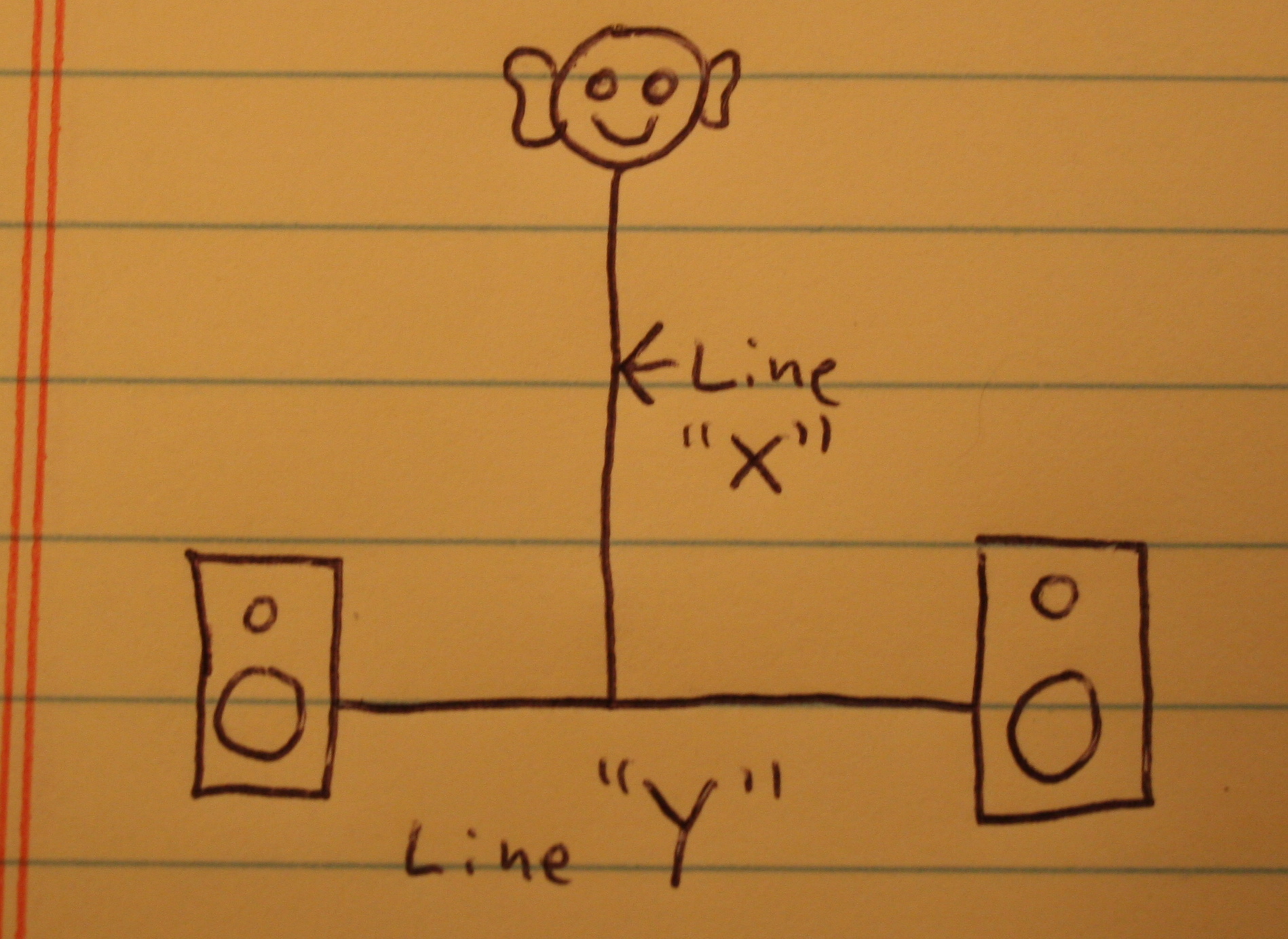
Here goes my attempt at some math. We know that Y is one leg of an equilateral triangle. By drawing line X, we are bisecting an equilateral triangle, or a 60,60,60 triangle, and turning it into two 30, 60, 90 triangles. The angle where X meets Y is a right angle, or a 90 degree angle. The angle between Line Y and the Line between the listener and the speaker is 60 degrees, so the remaining angle must be 30 degrees.
30, 60, 90 triangles have a special property where we always know that if the shortest leg has a length of A, then the hypotenuse has a length of 2A, and the other leg has a length of √3A. This is why a 30, 60, 90 triangle is sometimes called a 1,2,√3 triangle.
So, if we are given the distance X, then the short leg must be X/√3. The hypotenuse must be 2(X/√3). Therefore, we can reduce this toY=X*2/√3, or Y≈1.15X.

 biking with angie